
For months, Bethany had been doing what most small business owners do: posting on Instagram when she remembered, boosting posts when sales dipped, and saving content ideas she never executed. She didn’t need convincing that she needed help, and knew she either have to build a marketing team in-house or hire a marketing agency.
So, when she finally decided to hire a marketing agency, it didn’t feel exciting. It felt overdue. But what she didn’t know was how to hire a marketing agency without making any expensive mistakes.

Because once you start searching, every agency sounds the same. “We help brands scale.” “We deliver results.” “We will grow your online presence.” The language is polished, the promises are identical, and none of it tells you whether this agency is the right fit for your business. What you need is a clear, structured way to choose well.
This is that guide.
Step 1: Get Clear On What You Actually Need
Before you reach out to a single agency, pause. One of the most common and costly mistakes business owners make is outsourcing their confusion. You cannot say “I need marketing” and expect a meaningful outcome, because marketing is not one thing; it’s a system. And what you need from that system depends entirely on where your business is currently struggling.
For Bethany, the assumption was simple: “I need someone to handle Instagram.”
But when she took a step back, she realised her real problem wasn’t posting frequency, it was a lack of direction. Her messaging was inconsistent, her content had no clear purpose, and nothing connected to anything else. That single realisation changed her entire search.
Instead of looking for someone to “post,” she started looking for an agency that could provide strategy, and that shift matters more than most business owners realise. Because businesses that take a structured, strategy-first approach to marketing consistently see stronger returns.
Before you shortlist any agency, define your biggest bottleneck, your primary goal (sales, leads, awareness, or positioning), and what success should look like in three to six months. Without that clarity, every agency will sound right, and that’s exactly how people end up choosing wrong.
Step 2: Set a Realistic Budget, Not an Aspirational One
Bethany’s first agency was the most affordable option she could find. The promise sounded comprehensive: full social media management, content, and ads at a comfortable price. Within weeks, the cracks showed. The content lacked depth, there was no coherent strategy, and everything felt reactive. Three months later, she was back to square one, just with less money.
The lesson isn’t that cheap agencies are always bad; it is that good marketing is an investment, not a quick fix. In fact, industry data shows that small businesses typically allocate around 5–10% of their revenue to marketing, with a growing share going into digital channels.
That doesn’t mean you need the most expensive agency available. It means your expectations need to match your budget.
If your budget is limited, the smarter move is to focus on one core service first, strategy plus content, for example, or to work with a smaller, more specialised agency. Paying for everything and receiving very little impact on any of it is one of the most avoidable mistakes in this process.
Step 3: Shortlist Based on Expertise, Not Popularity
A long list of agencies is not a useful list. Bethany noticed early on that some agencies were popular, had impressive client logos and stunning portfolios, but still lacked the expertise relevant to her situation. An agency can be genuinely excellent and still be entirely wrong for your business.
Real expertise means understanding your industry, knowing how your audience makes decisions, and having experience solving the specific kind of problems you’re facing. Knowing how to hire a marketing agency well means looking past the surface
When evaluating options, the more useful question is not “Who looks the best?” but “Who understands businesses like mine?”
According to research by Clutch, 83% of small businesses plan to maintain or increase spending on outsourced services, with many citing access to expertise and cost efficiency as key reasons.
In other words, businesses don’t just hire agencies to “do marketing,” they hire them to bring in knowledge they don’t already have.
When evaluating expertise, look for relevant industry experience, proven results with businesses of similar size, and evidence that they understand your market dynamics. An agency that already knows your space will require far less hand-holding and will produce results faster.
An agency that understands your space will require less guesswork and deliver results faster.
Step 4: Look Beyond Aesthetics “Ask for Proof”
It’s easy to get impressed by a beautiful social media page, clean designs, viral-style videos, and trend-driven content. But here’s the uncomfortable truth: aesthetics alone do not equal effectiveness.
Bethany almost signed with one agency based entirely on how good their own page looked. When she started asking deeper questions, the cracks appeared quickly.
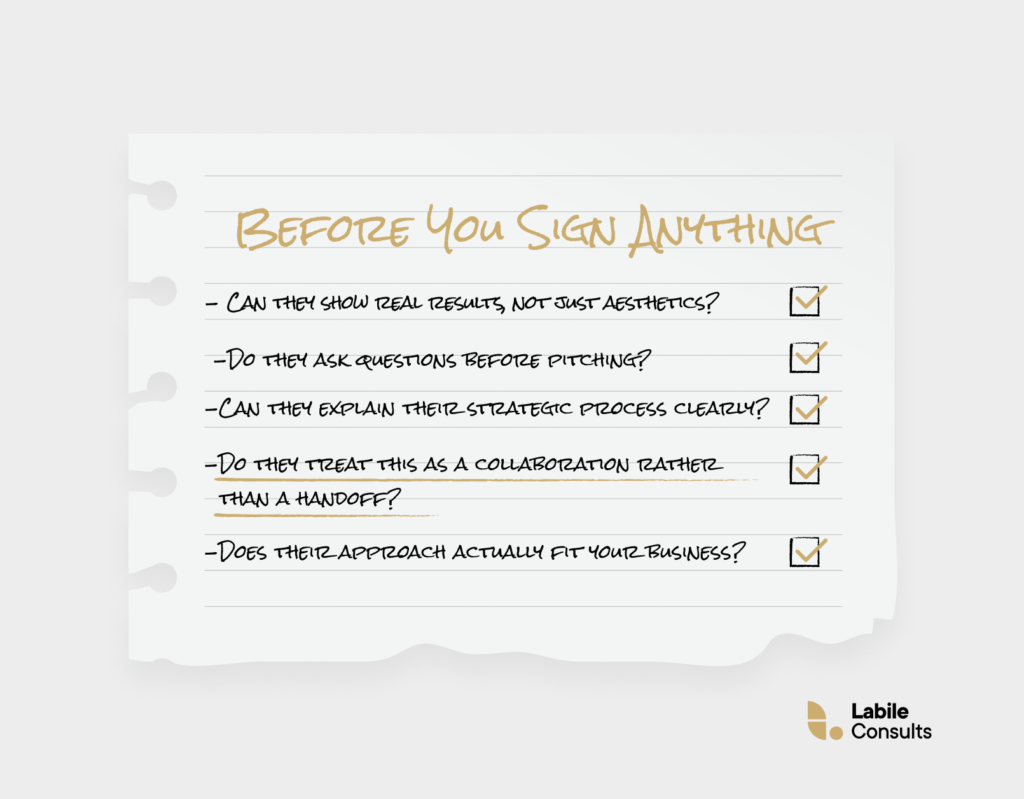
They struggled to explain their strategic process, how they measure success, or what results they had actually delivered for clients. That was her cue to step back.
What you should be asking every agency you meet is whether they can show case studies with real performance data, what metrics they prioritise, how they approach strategy for a new client, and what success looks like in their process. You are not hiring for content. You are hiring for outcomes. Make sure they can demonstrate both.
Step 5: Evaluate Their Thinking, Not Just Their Execution
Execution is visible. Thinking is not, but it’s what drives everything.
The agency Bethany eventually chose didn’t lead with visuals or case study decks. They started by asking questions she hadn’t fully considered: Who are your most profitable customers? Why should someone choose you over the alternatives? What has worked before, and why?
That distinction matters enormously. A strong agency doesn’t only execute tasks; they bring strategic thinking into your business. They help you identify gaps in your positioning, refine how you communicate your value, and make better decisions over time. If an agency’s pitch is entirely about what they will do and never about how they think, treat that as a warning sign. You don’t need someone to take instructions, you need someone who can help guide direction.
Step 6: Assess How They Work With Clients
Hiring a marketing agency is not a handoff. It is a collaboration, and this is the part many business owners underestimate. Bethany initially assumed she could step back completely once she had signed. She quickly discovered that the best results came from working with the agency, not just delegating to them.
The right agency will involve you in key decisions, seek your input on brand direction, and keep you informed on performance and adjustments without overwhelming you with unnecessary detail. Look for clear communication channels, regular structured reporting, and genuine openness to feedback in both directions. If an agency feels distant, rigid, or purely transactional from the first conversation, that dynamic rarely improves once the contract is signed.
Growth happens faster when there’s alignment and active collaboration.
Step 7: Pay Close Attention to How They Communicate
Before Bethany made her final decision, she paid attention to something simple but revealing: how each agency on her shortlist communicated during the evaluation process itself. One took days to respond. Another sent generic, copy-paste replies. One stood out by being clear, timely, and genuinely engaged; they didn’t just respond, they moved the conversation forward.
That became a deciding factor because communication during the sales process is a direct preview of how communication will go once you’re a client. Poor responsiveness now will only worsen later. Generic replies now will translate into generic work. You are not just hiring a service; you are entering a working relationship, and the quality of that relationship will shape everything that follows.
Step 8: Understand the Scope Before You Commit
Marketing services can be deliberately vague if you don’t ask the right questions. “Content creation” can mean a handful of things depending on the agency. “Management” can range from basic scheduling to full strategic oversight. Bethany learned to slow down at this stage and ensure that every deliverable was defined in writing before she committed.
Before signing, clarify exactly how many posts, videos, or campaigns are included; what the turnaround and revision policy looks like; how performance will be reported and how often; and what the day-to-day communication structure will be. If something is ambiguous now, it will become a source of friction later. Clarity at the start protects both sides throughout the relationship.
Step 9: Look for Alignment, Not Just Capability
By the final stage, Bethany had narrowed her shortlist to agencies that were all capable. What separated the right choice from the rest was alignment. The agency she chose understood her brand voice, respected her vision, and built strategies that felt authentic to her business rather than borrowed from a generic playbook.
The most technically capable agency will still struggle if they don’t genuinely understand what you’re building. Ultimately, knowing how to hire a marketing agency comes down to this.
Find one that combines real expertise with real alignment, when their thinking makes sense, their process feels structured, and their approach fits the direction you’re heading. That’s when you’ll know.
Six months later, Bethany’s marketing was no longer something she fitted in around everything else. It was intentional, structured, and working.
Final Thoughts: Be Thorough, Then Be Decisive
Knowing how to hire a marketing agency is not about finding the flashiest pitch or the lowest price. It takes time, honest evaluation, and the discipline to resist pressure to move fast simply because an agency is pushing for a quick close. Take that time; the right fit will be worth the patience.
That said, once you’ve found it, move. Waiting too long to act on a good decision costs just as much as making a bad one. If you’ve read this far, you’re not just gathering information; you’re ready to make a move.
At Labile Consults, we work with small businesses and growing brands that are ready to move from inconsistent, reactive marketing to a structured, results-driven approach. Our approach is built on strategic clarity, deep market understanding, collaborative execution, and measurable outcomes. We don’t believe in guesswork or one-size-fits-all solutions. We build marketing systems that work consistently because your business deserves more than another agency that sounds like the rest. If you’re ready to partner with a team that brings both expertise and intentional execution, book a consultation with Labile, and let’s help you get marketing right.