

At some point, almost every growing business faces the same question. Whether to hire a marketing agency or build a marketing team in-house is one of the most important decisions a small business owner can make, and the answer is rarely straightforward.
The good news is that there is no universally correct answer. The right choice depends on your goals, budget, industry, and, honestly, how much you enjoy managing people.
Before you even weigh both options, however, it’s worth being clear on what your marketing system actually needs to accomplish. If you haven’t yet defined your channels, messaging, or customer journey, our guide on marketing strategies for small businesses in 2026 is a useful starting point.
This article explores both sides of the argument without sugar-coating either. We’ll explore the benefits and trade-offs of the marketing agency vs in-house debate, walk you through the questions worth asking before you decide, and help you figure out which path fits your business right now.
Why the Marketing Agency vs In-House Decision Matters
Marketing is no longer just one department’s responsibility. It’s the engine that powers customer acquisition, brand reputation, revenue growth, and long-term competitive positioning. In a landscape where, according to Forrester, 94% of buying groups vet solutions through AI tools before ever contacting a vendor, your marketing needs to be strategic, consistent, and credible across multiple channels.
As VerticalResponse’s 2026 marketing research highlights, modern businesses can no longer simply drive traffic to a website and hope for conversions. The focus has shifted to building sustainable brand authority, becoming a trusted, cited-everywhere source in your niche. Whoever handles your marketing isn’t just spending your budget; they’re shaping your business’s future.
So what does each option actually look like in practice? Let’s start with the case for working with an agency, since it’s the strongest starting point for most small businesses.
Why Should You Hire a Marketing Agency?
For most small businesses at an early to mid-growth stage, a marketing agency is likely the smarter first move. Here’s why.
1. You Get a Whole Team, Not Just One Person
When you hire an in-house marketer on a small business budget, you’re hiring one person. That person will need to write copy, manage social media, run email campaigns, interpret analytics, optimise for search, and probably design graphics too. The odds of finding someone who genuinely excels at all of that are slim.
A marketing agency, by contrast, comes with a built-in bench of specialists. As Simon Kingsnorth, author of The Digital Marketing Handbook, notes in Maddyness’s breakdown of the agency vs. in-house debate: working with an agency gives you access to a whole team with a diverse range of skills, from copywriting and PPC to graphic design and videography, without the hassle of hiring and managing a marketing dream team yourself.
2. Agencies Stay Ahead of the Curve
Digital marketing moves fast. Algorithms change, new platforms emerge, and even consumer behaviour shifts. An agency’s entire business model depends on staying current, so it invests heavily in training, tools, and trend monitoring. Your in-house hire, no matter how talented, is working within the bandwidth of a single person’s attention.
The context here is that agencies spend to keep their teams up to date, so you get the benefit of fresh knowledge and strategies without in-house training costs. This is particularly relevant as AI-driven discovery, LLM-based search, and short-form video continue to reshape how customers find and vet businesses.
3. Scalability Without the HR Headache
One of the most practical advantages of working with an agency is flexibility. If you’re launching a new product and need to triple your marketing output for three months, an agency can scale up. If things slow down, you scale back, no salaries to carry, no redundancy processes to manage.
For small businesses where revenue fluctuates, as it almost always does in the early years, this flexibility isn’t just convenient; it’s financially prudent.
4. Access to Premium Tools and Data
Professional agencies invest in enterprise-level tools for SEO analysis, social media management, A/B testing, email automation, and campaign analytics. These tools are expensive, often running into thousands per year. As Forbes Agency Council contributor Owen Garitty explains, agencies also typically have a wide network of industry connections that can provide access to new opportunities and resources an in-house team simply couldn’t replicate.
5. A Fresh, External Perspective
It’s easy to become too close to your own brand. When you know every product detail, every internal debate, every small nuance, communicating simply and compellingly to someone who knows nothing about you becomes surprisingly difficult. Agencies see your business the way your customers do, and that outsider perspective often surfaces positioning opportunities and creative angles an internal team would never notice.
Challenges of Working with a Marketing Agency
In the spirit of objectivity, working with an agency does come with real risks:
- Lack of niche familiarity: Agencies handle clients across industries and may not immediately grasp the nuances of your specific market, leading to campaigns that feel slightly off-brand.
- Communication gaps: Without a strong internal champion who can liaise efficiently with the agency, briefs get misinterpreted, and timelines slip.
- Hidden costs: Always insist on a clear scope of work and defined deliverables before signing. Vague pricing structures are a red flag.
- Less immediate control: You’re not in the room when campaigns are being built. For owners deeply involved in day-to-day operations, this can feel uncomfortable.
That said, the agency model isn’t the right fit for every business. For some, building an internal team is the smarter long-term play, and there are genuine reasons why.
Why Should Your Marketing Team Be In-House?
There’s a reason many businesses, particularly larger, more established ones, ultimately bring their marketing in-house. The model has real advantages worth taking seriously.
1. Deep Brand Knowledge and Authentic Voice
Nobody knows your business like the people inside it. An in-house team attends product launches, sits in on sales calls, and feels every shift in company direction as it happens. As Emma Hart of Resolution writes in her analysis for Business Biscuit, an internal team has deeper knowledge of the business’s values and short- and long-term goals, making them better equipped to craft a strategy that aligns perfectly with your desired direction.
In today’s environment, where consumers are increasingly sceptical of polished, corporate content, authenticity can be a genuine competitive advantage.
2. Real-Time Content and Faster Turnarounds
Something exciting happens at your office today. A customer shares a brilliant testimonial. You’ve got a timely take on a trending story. An in-house team can capture and publish that content immediately. Routing it through an agency involves briefs, approvals, and turnaround times that can blunt the impact of timely content.
For brands where cultural responsiveness and real-time social media presence are central to the identity, hospitality, fashion, and food, in-house often wins on agility.
3. Brand Advocacy and Stakeholder Relationships
When journalists, influencers, or commercial partners engage with your business, there’s often a preference for speaking directly to someone inside the company. An in-house marketer acts as a genuine brand ambassador, someone who can answer questions with authority and build relationships that an agency contact simply cannot replicate.
4. Long-Term Institutional Knowledge
Over time, an in-house marketer builds an invaluable repository of institutional knowledge: which campaigns worked, which messages fell flat, and what your audience responded to three years ago versus today. That compounding knowledge is a real asset. Agencies rotate account managers, change teams, and occasionally lose your history when key contacts move on.
The Real Challenges of Going In-House
The in-house route is not without significant complications for small businesses.
- Cost of employment: A mid-level marketing manager earns between £35,000 and £55,000 per year before benefits, equipment, software subscriptions, and training. That’s a substantial fixed overhead for a lean operation.
- Skill gaps are inevitable: No one can do everything well. You’ll likely still need to outsource specialist work, such as paid ads, video production, and technical SEO, which can quietly erode the cost advantage of hiring in-house.
- Dependency risk: When your in-house marketer leaves, you lose continuity, institutional knowledge, and momentum, often at the worst possible time.
- Management requires marketing literacy: To hire, direct, and evaluate a marketer, you need to understand enough about marketing to know whether what they’re doing is actually working. Many small business owners aren’t in a position to provide that oversight effectively.
Both models have clear strengths and real limitations. The question is which trade-offs make most sense given where your business is right now. Here are four questions that will help you work that out.
How to Decide: Marketing Agency vs In-House Team
So, how do you decide whether to build your marketing team in-house or hire an agency? Rather than relying on general advice, sit with these four questions honestly:
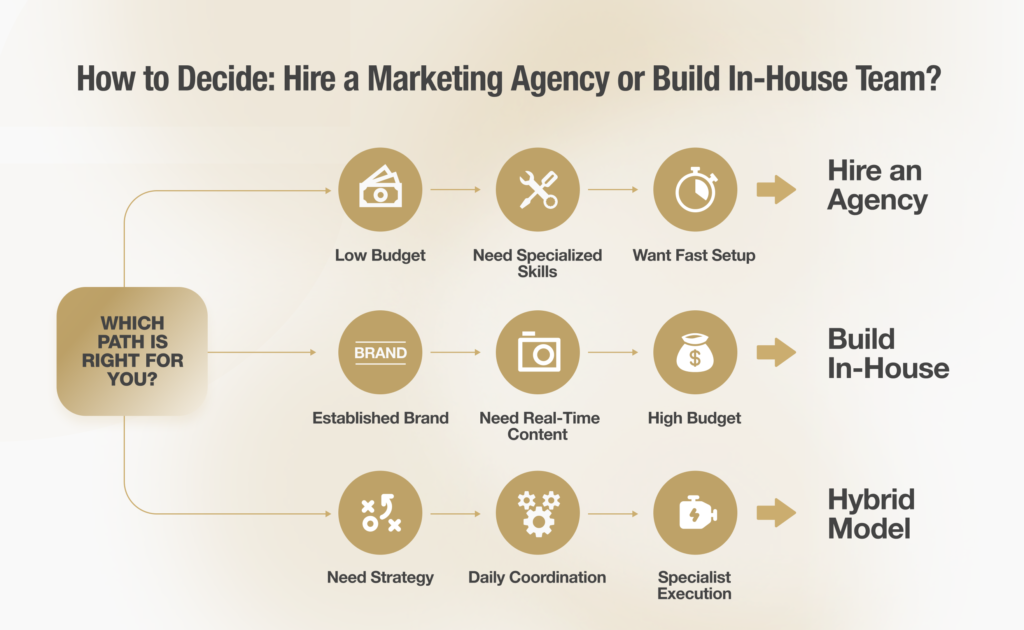
- What is your budget, really? Be candid about what you can afford to spend sustainably. If a full salary plus tools, training, and benefits would strain your finances, an agency retainer, which can range from £1,500 to £5,000 per month for a small business, may actually provide more marketing firepower per pound.
- How established is your brand voice? If your brand identity is still being defined, an agency can help you shape it. If it’s well-established and deeply nuanced, an in-house team may be better positioned to protect and execute it with the consistency it deserves.
- How fast do you need results? Agencies can move faster in the early stages; they already have systems, tools, and processes in place. There’s no onboarding curve, no training period, no ramp-up time. If you’re under commercial pressure to generate leads quickly, that head start matters.
- How hands-on do you want to be? Some business owners want daily visibility into marketing activity. Others want to set goals and check in monthly. Agencies work best when you have a clear internal champion who can manage the relationship; in-house is better if you need constant oversight and deep integration with other departments.
If you’ve worked through those questions honestly, a pattern should be emerging. The image below will help you translate your answers into action:
The Verdict: Our Honest Opinion
If you’re an early-stage or growing small business weighing this decision, the honest answer for most is: start with an agency.
Not because in-house is wrong, it isn’t. But because most businesses haven’t yet validated their marketing channels, defined their messaging, or proven what drives customer acquisition, building an internal team too early is an expensive way to learn the hard way.
An agency gives you access to expertise across every marketing discipline, content, SEO, paid media, email, and social, without the fixed overhead of employment. Once you understand what actually drives growth for your specific business, you’ll be far better positioned to know which roles make sense to bring in-house.
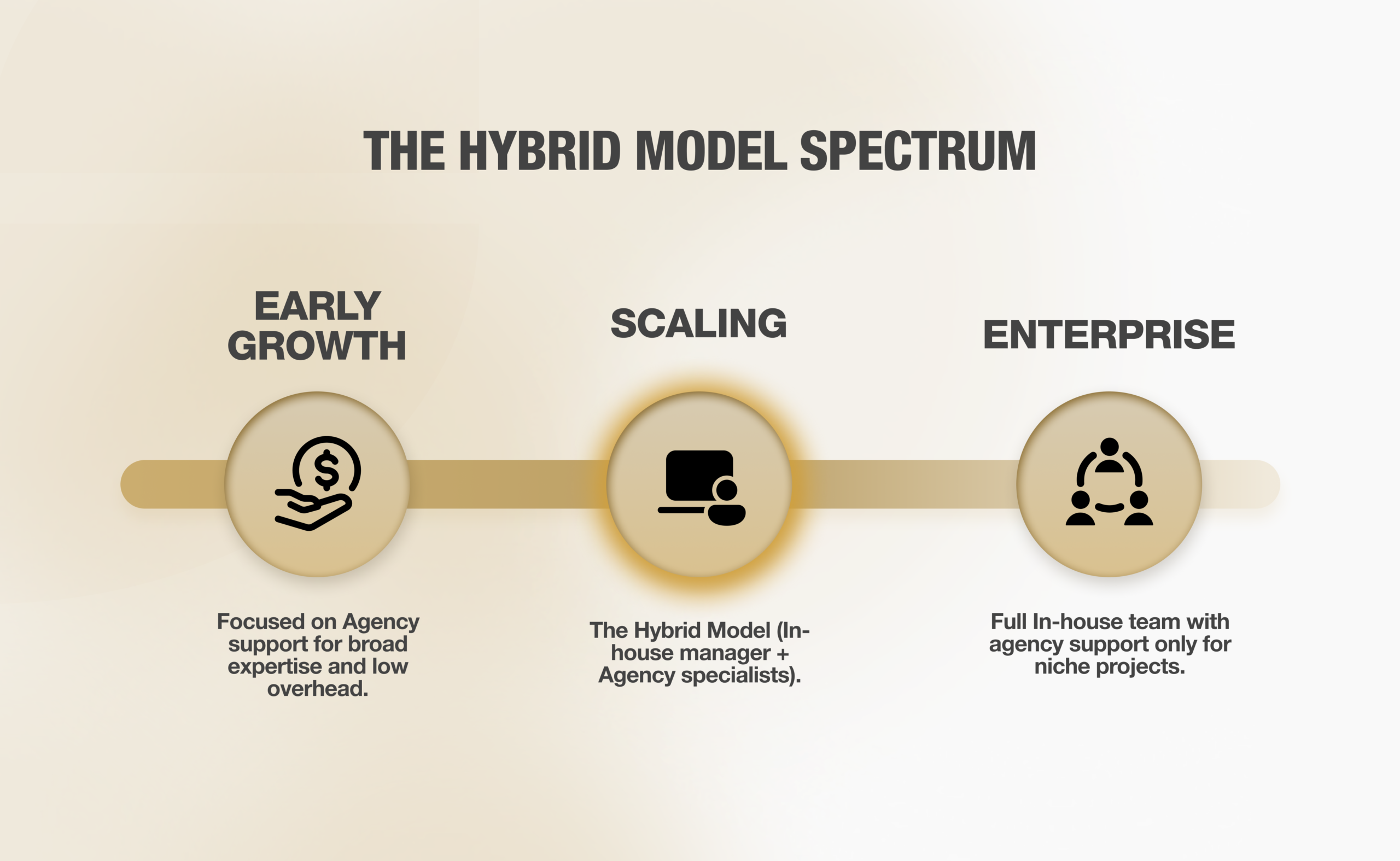
Many businesses ultimately land on a hybrid model: an agency handling specialist work. SEO, paid media, and content production, while an in-house coordinator manages day-to-day brand activity and stakeholder relationships. That combination often delivers the best of both worlds.
Whatever you decide, the worst outcome is indecision: sporadic posts, inconsistent messaging, and marketing that reacts rather than leads. Strategy, consistency, and clarity matter far more than the model you choose to execute it with.
Not Sure Which Marketing Agency to Hire?
If you’ve been piecing together a marketing strategy without a clear system. Or you’re simply unsure where to start, a conversation with the right agency can be genuinely clarifying.
At Labile Consults, we work with small and growing businesses to build integrated marketing strategies grounded in your specific goals, audience, and resources. We don’t do cookie-cutter campaigns. We do thoughtful, evidence-led marketing that actually moves the needle. Book a consultation today and let’s talk about where your marketing is now, where you want it to go, and how to close the gap.