
You’re at a networking event, coffee in hand, when someone casually mentions their new PPC marketing strategy. Later that afternoon, you notice a competitor’s name sitting comfortably at the top of Google. And by Friday, a marketing agency drops the acronym into a proposal, and through all of it, you’re nodding along while quietly thinking: What does this actually mean for my business? Is this yet another form of advertising?
Well, you are in luck because this guide starts from the basics. It explains PPC marketing, defines the terms you will encounter, addresses the myths that often confuse beginners, and helps you understand enough to make an informed decision about whether it belongs in your business’ overall marketing strategy or not.
But first, let’s start with the simplest question of all.
What Does PPC Mean?
PPC stands for Pay-Per-Click. PPC, in its simplest form, is this: you run an ad online, and you pay a small fee each time someone clicks on it. That is the entire model.
You are not paying for your ad to be shown, nor for people to see it. You pay only when a person looks at your ad and decides to click it. Unlike traditional advertising channels, such as billboards, local print newspapers, or radio spots, where you pay a fixed upfront fee regardless of how many people pay attention or respond, PPC advertising flips the model on its head.
For instance: In traditional advertising, if 10,000 people drive past your billboard and zero people call your office, you still pay the full price of the billboard. While in PPC Advertising, you pay for action (the moment a user demonstrates intent by clicking your ad). If your ad is displayed to 10,000 people on a search engine or social platform, but nobody clicks it, you are charged nothing for those display impressions.
The most common form of PPC marketing is Google Ads. When you type something into Google and see results at the top of the page labelled “Sponsored,” those are PPC ads. The businesses behind them have chosen the search terms they want to appear for and agreed to pay Google a fee each time someone clicks through to their website. Facebook, Instagram, LinkedIn, Microsoft Bing, and YouTube all offer similar models, too.
In one sentence: PPC advertising is an online model where businesses pay only when someone clicks their ad, not when it is shown.
You see, understanding the name is one thing, but knowing why millions of businesses choose PPC over other forms of advertising is another. That’s where it’s real value begins.
So, Why Do Businesses Use PPC Marketing?
Simply put, PPC marketing can put your business at the top of search results within hours of launching a campaign. For a curious mind, another question would be: why would a business pay for clicks when organic search exists?
The answer is that PPC and organic search do different jobs. Appearing on Google through SEO takes months of consistent effort. If you have a time-sensitive promotion, a new product to introduce, or simply cannot wait six months for organic rankings, PPC delivers traffic immediately.
The other reason PPC marketing for beginners is worth understanding is intent. When someone searches ’emergency electrician Manchester’ or ‘wedding photographer Bristol,’ they are not browsing. They are ready to hire someone. PPC advertising puts your business in front of people at precisely this moment of decision, which is why paid search traffic tends to convert at a higher rate than most other channels.
And as useful as PPC is, it doesn’t exist in isolation. It’s one of several digital marketing channels businesses use to reach and convert customers. Think of digital marketing as a toolbox. Each tool has a different purpose, and PPC marketing is simply one of them. Some tools help people discover your business over time, while others, like PPC, help you reach potential customers much more quickly.
| Digital Marketing Channel | Primary Purpose | Typical Results Timeline |
| Search Engine Optimisation (SEO) | Improve organic visibility on search engines | Medium to long term |
| PPC Marketing | Generate immediate targeted traffic through paid advertising | Immediate |
| Content Marketing | Educate audiences and build authority | Long term |
| Social Media Marketing | Build awareness and engage communities | Medium to long term |
| Email Marketing | Nurture leads and encourage repeat purchases | Ongoing |
| Conversion Rate Optimisation (CRO) | Turn more visitors into customers | Ongoing |
PPC Marketing The Terms You Need to Know
Now that you understand where PPC sits within digital marketing, the next challenge is understanding the language.
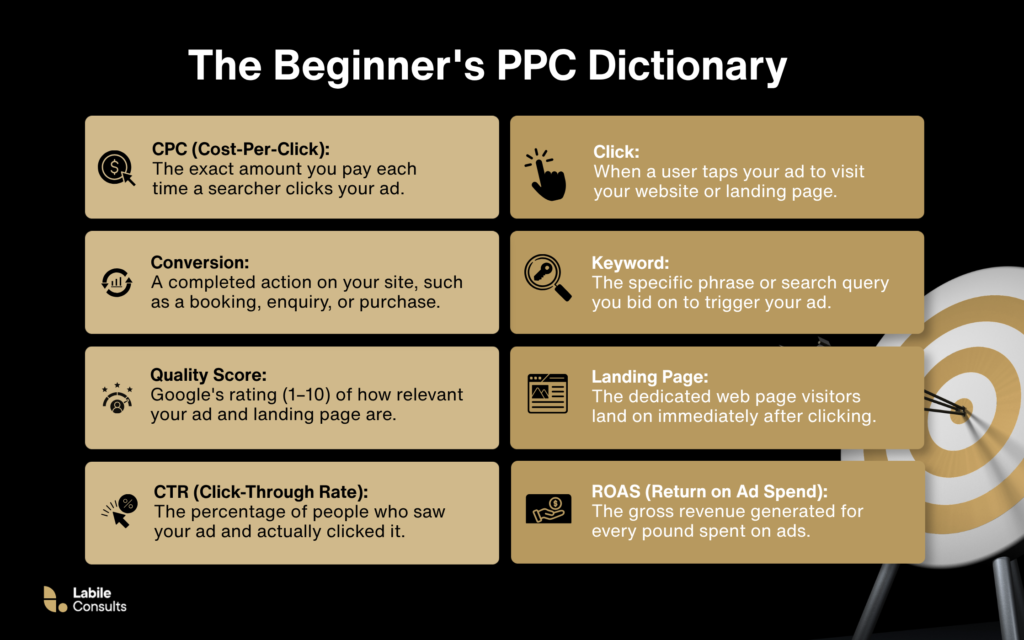
One of the most frustrating things about learning PPC marketing for beginners is the language. Agencies, advertising platforms and campaign reports all use technical phrases that assume you already know what they mean. You do not need to memorise these, but recognising them will make every future conversation significantly easier.
- Impression: Every time your ad is displayed to someone online, that counts as one impression. In PPC advertising, impressions are free; you only pay when a click happens.
- Click: When someone sees your ad and taps or clicks on it. This is the action that triggers a payment.
- CPC (Cost Per Click): The amount you pay each time your ad is clicked. CPC varies widely depending on how competitive your chosen keywords are and how relevant your ad is.
- CTR (Click-Through Rate): The percentage of people who see your ad and click it. If 200 people see your ad and 6 click it, your CTR is 3%. A higher CTR means your ad is relevant and compelling to the people seeing it.
- Keyword: The search term you want your ad to appear for. If you run a dog grooming salon in Leeds and bid on ‘dog groomer Leeds,’ your ad shows when someone searches that phrase.
- Ad Copy: The written content of your ad. The headline and description that appear in search results. Strong ad copy is specific, relevant, and gives the reader a reason to click.
- Landing Page: The page someone arrives at after clicking your ad. This is where the conversion happens, or doesn’t. The landing page is the single biggest factor in whether your PPC spend produces results.
- Conversion: A desired action taken by someone who clicked your ad. Conversions vary by business: a completed contact form, a phone call, a booking, a purchase, or a newsletter sign-up.
- CPA (Cost Per Acquisition): How much you spent on ads divided by the number of conversions. If you spend £300 and get 15 enquiries, your CPA is £20 per enquiry.
- Quality Score: Google’s rating (1 to 10) of how relevant your keyword, ad, and landing page are to each other and to the searcher. A higher Quality Score earns better ad positions at lower cost.
- Bid: The maximum amount you are willing to pay per click for a keyword. Your actual cost per click is usually lower.
- Budget: The daily or monthly cap on your total ad spend. When your budget is exhausted, your ads stop showing until it resets.
- Campaign: The top-level structure in your advertising account where you set your objective, budget, and targeting.
- Negative Keywords: Search terms you specifically exclude from your campaign so your ad does not show for irrelevant searches. A premium accountant might exclude ‘free’ and ‘DIY’ to avoid wasting budget on people who will never hire them.
- ROAS (Return on Ad Spend): How much revenue you generated for every pound spent on ads. If you spend £100 and make £500 in sales, your ROAS is 5x.
- Ad Extensions: Additional information attached to your search ad, such as your phone number, address, links to specific pages, or star ratings. Extensions make your ad more visible and informative without increasing the cost per click.
- Retargeting: Showing ads specifically to people who have already visited your website. Because they already know your business, they are a warmer audience and tend to convert more efficiently.
- Impressions Share: The percentage of available impressions your ad actually received. A low impressions share often means your budget or bid is limiting how often your ads show.
The good news is that you don’t need to become an expert in every one of these terms before launching your first PPC campaign. A good PPC specialist or agency should explain what matters for your business in plain English rather than overwhelming you with technical jargon.
By now, you should have a clearer understanding of what PPC marketing is and the language that surrounds it. However, understanding the basics is only half the battle. Many first-time advertisers are discouraged by misconceptions that make PPC seem more complicated, expensive or risky than it really is. Let’s separate the myths from the facts.
PPC Marketing Facts vs Myths: What Most Beginners Get Wrong
One of the biggest obstacles to getting value from PPC marketing is the misinformation that surrounds it. These are the most common myths beginners encounter, alongside the reality.
| Myth | Fact |
| ‘The biggest budget always wins.’ | Not true. Google’s auction rewards relevance, not just spend. A well-written, highly specific ad for a local keyword can outperform a large competitor’s generic ad even with a smaller budget, because Quality Score competes with bid amount. |
| ‘PPC produces results instantly.’ | Partially true. Your ads can go live quickly, but the campaign needs time to gather data, exit its learning phase, and optimise. Judging a campaign after three days is like deciding a recipe doesn’t work before the oven has finished preheating. |
| ‘PPC is too expensive for small businesses.’ | This depends entirely on your industry and keywords. Local service businesses can run effective campaigns for £25 to £50 per day. The main question should be if your conversion rate justifies the cost per click in your market. |
| ‘Once you set up a campaign, it runs itself.’ | False. PPC advertising requires ongoing management: reviewing search terms, adding negative keywords, testing ad copy, adjusting bids, and improving landing pages. A campaign left unattended deteriorates in performance over time. |
| ‘More clicks means more customers.’ | Clicks are a means to an end, not the end itself. A campaign generating high-volume, low-quality clicks from people who were never going to buy from you is wasted spend. The goal is relevant clicks that convert, not volume for its own sake. |
| ‘PPC is only for Google.’ | PPC advertising runs across multiple platforms: Facebook, Instagram, LinkedIn, YouTube, Microsoft Bing, TikTok, and Pinterest all offer pay-per-click models. Google Search is the most common starting point, but it is not the only option. |
| ‘If my ad isn’t working, I just need to spend more.’ | Spending more on a poorly built campaign produces worse results faster. Before increasing the budget, the priority is to fix the fundamentals: keyword targeting, ad copy, and the landing page traffic arrives at. |
| ‘PPC replaces SEO.’ | PPC and SEO are complementary, not competing. PPC delivers immediate traffic that stops when you stop paying. SEO builds durable organic visibility that compounds over time. Most mature marketing strategies use both. |
Where Can You Find PPC Ads?
PPC advertising shows up in more places than most beginners expect. Once you understand PPC marketing, you will start recognising paid ads everywhere you look online.
- Google Search is the most common starting point. Text ads at the top and bottom of search results, marked ‘Sponsored.’ These capture people actively searching for something specific, which is why they tend to convert well.
- Google Display covers banner and image ads that appear on websites and apps across the internet while you browse. These are better for brand awareness and retargeting past visitors than for capturing immediate buying intent.
- YouTube shows video ads before and during videos. YouTube processes over three billion searches per month, making it the second largest search engine in the world. Video PPC advertising works well for businesses with a story to tell or a product that benefits from demonstration.
- Facebook and Instagram operate on a pay-per-click or pay-per-impression model. Unlike Google Search, social PPC reaches people based on who they are rather than what they are searching for. Our article on Facebook and Instagram advertising for small businesses covers this in detail.
- LinkedIn is the strongest PPC platform for B2B businesses. Sponsored content and message ads reach professionals by job title, company size, and industry.
- Microsoft Advertising (Bing) works similarly to Google Ads but on Bing’s search engine. Often overlooked, it can offer lower cost per click in competitive markets and reaches a demographic that skews slightly older and more professional.
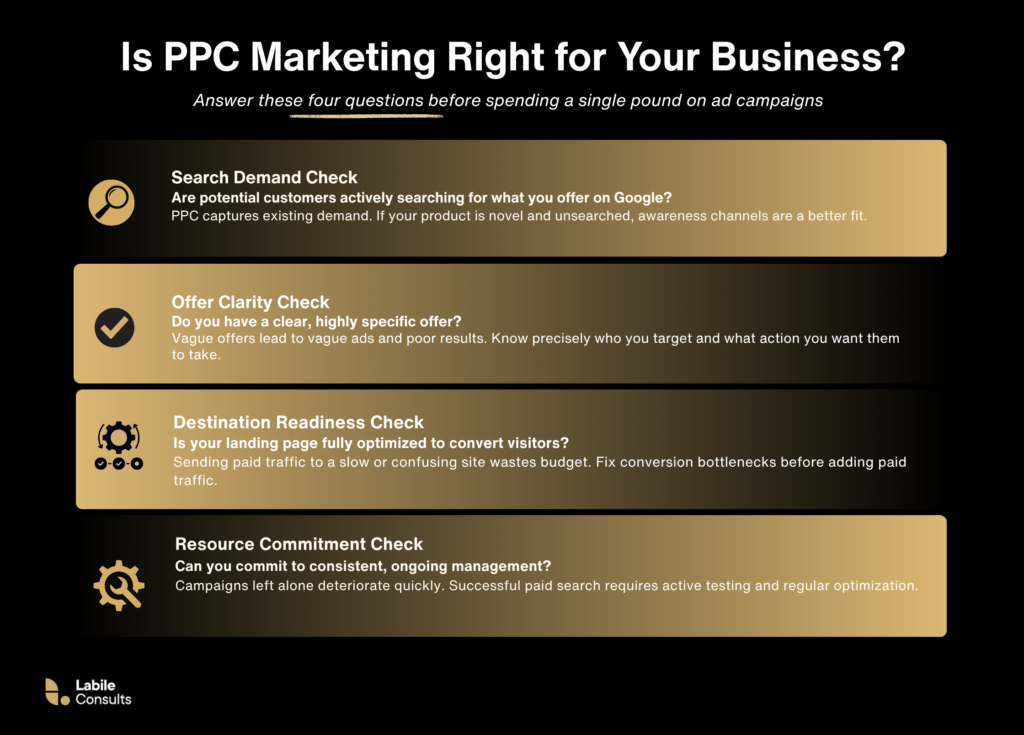
By now, you should have a clearer understanding of what PPC marketing is and where it fits within digital marketing. That doesn’t automatically mean it’s the right choice for every business. Before investing in paid advertising, it’s worth asking yourself a few practical questions about your business, your goals and your readiness to manage a campaign. Use the checklist below as a quick self-assessment before taking the next step.
Need Help Launching Your First PPC Marketing Campaign?
At Labile Consults, we work with small businesses at every stage of their digital marketing journey, including the very beginning. If you want to understand whether PPC marketing is the right move for your business, what it might realistically cost, and what results you could expect, speak to us and we will be happy to give you the best possible answers.
Book a free consultation today, and let’s work out which PPC services your business actually needs to achieve your targets.