
PPC for small businesses is one of the many “streets” in the digital marketing neighbourhood, and as a small business owner, it is easy to get lost wandering if you are unsure of what you want.
When exploring the streets of Digital Marketing, you could take the slow route of organic content creation, building up your brand visibility block by block through our primary small business guide to on-page SEO and waiting months for search engines to notice your footprint.
Or, you could take the fast, high-traffic highway of paid advertising. When you need to get your products or services directly in front of buyers today without waiting on algorithm luck, that highway usually leads straight to one highly specific destination: PPC.
The goal of this guide is to explain PPC for small businesses in plain language, without assuming you already know what any of it means. By the end, you will understand what PPC is, how it works, what you are actually paying for, what makes a campaign succeed or fail, and whether it is the right move for your business right now.
So, What Is PPC Advertising?
PPC is an acronym for pay-per-click. It is a form of online advertising where you only pay when someone clicks on your ad. As its name suggests, you are not paying to have the ad shown; you are paying for the moment someone sees it and decides to act.
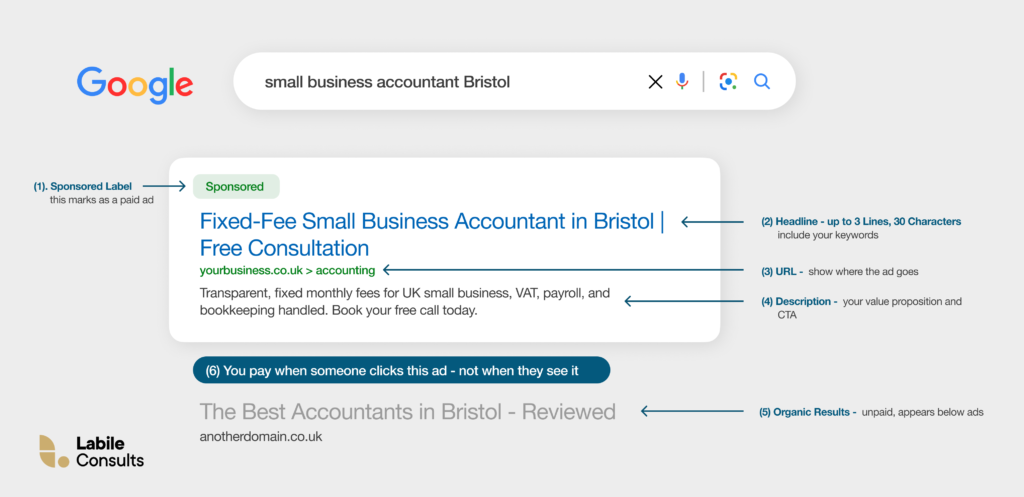
The most common form of PPC for small businesses is Google Ads. When someone types a search into Google, the results they see at the top of the page, marked with a small “Sponsored” label, are PPC ads. The businesses behind those ads have told Google: “I want my business to appear when someone searches for this.” And they pay a certain amount of money every time someone clicks through to their website or landing page.
Several other platforms offer PPC advertisements, too. Facebook and Instagram ads, LinkedIn ads, and Microsoft Ads (which runs on Bing) all operate on versions of the same model. But Google Ads is where most small businesses start, because it captures people at the moment they are actively searching for something, which is one of the highest-intent moments in the entire customer journey.
PPC is a way to put your business in front of people who are actively searching for what you offer, and you only pay when they click on your advertisement(s).
How Does PPC For Small Businesses Actually Work?
Behind every PPC ad is a system that decides which ads appear, in what order, and at what cost. Understanding this system is the difference between spending your marketing budget wisely and spending it blindly. Before we explore even further, it’s important to mention that the success of your PPC campaign largely depends on your entire marketing plan. In other words, it’s a bad marketing practice to launch PPC advertisements in isolation, without first having your overall marketing strategy and sales funnel properly defined and set up. If you don’t have them set up yet, here are the best marketing strategies for small business owners, alongside a comprehensive guide on how to create a sales plan for your small business.
So, how does pay-per-click advertising work for small businesses?
1. Keywords: The Foundation of Every PPC Campaign
Keywords are the search terms you want your ad to appear for. When you set up PPC for your small business, you need to choose a list of keywords relevant to your business. These are the phrases your potential customers are typing into Google.
A florist in Manchester might target keywords like ‘wedding florist Manchester,’ ‘flower delivery Manchester,’ or ‘birthday bouquets near me.’ An accountant in Bristol might target ‘small business accountant Bristol’ or ‘VAT returns help UK.’ The more specific and relevant your keywords are to your offer, the better your ads will perform and the less you will waste.
This is why keyword choice is the most important decision in any PPC campaign. The wrong keywords attract the wrong people. Broad, vague keywords attract browsers rather than buyers. Specific, intent-driven keywords attract people who are ready to act.
2. Bidding: What You Are Competing For?
Google does not simply sell ad space to the highest bidder. It runs an auction every time someone searches. You tell Google the maximum amount you are willing to pay per click (your bid), but your Quality Score also determines your ad’s position.
Quality Score explained: Google grades every ad on a scale of 1 to 10. The grade reflects how relevant your keyword is to your ad, how relevant your ad is to the page it links to, and how good that page experience is for the user. A high Quality Score means you can win better ad positions at a lower cost. A low Quality Score means you pay more for worse positions. This is why a good PPC for small business is about relevance, not just budget.
This matters for small businesses. A local business with a highly relevant, well-written ad targeting specific local keywords can outperform a larger competitor with a bigger budget but a less focused campaign. PPC is not purely a money fight. It rewards businesses that do the groundwork properly.
3. Ad Copy: What People Actually See
Your ad is what appears in the search results. On Google Search, a typical ad has a headline (up to three lines of text, each up to 30 characters), a description (up to two lines of supporting text), and your URL. That is a small amount of space to convince someone to click over every other result on the page.
Strong ad copy does three things. It confirms relevance, letting the searcher know immediately that your business offers exactly what they searched for. It communicates a clear benefit or differentiator, giving them a reason to choose you. And it includes a direct call to action that tells them what to do next. “Book a free consultation,” “Get an instant quote,” “Same-day delivery available.” Weak ad copy that is vague, generic, or fails to match the searcher’s intent wastes money regardless of budget.
4. Landing Pages: Where the Real Work Happens
One thing you must understand as a beginner is that the click is not the goal. The conversion is.
When someone clicks your ad, they land on a page of your website. What happens on that page determines whether you get a customer or waste your money. A landing page that is slow to load, hard to navigate, unrelated to what the ad promised, or missing a clear next step will kill your conversion rate regardless of how well the ad performed.
The single rule for landing pages in any PPC campaign for a small business is that the page must deliver exactly what the ad promised, and make it as easy as possible for the visitor to take the next step. If your ad promises a free consultation, the landing page should open with a booking form or a prominent phone number. If your ad promotes a specific product, the page should open on that product, not your homepage.
This connection between ad and landing page is not just good practice. It directly affects your Quality Score, which affects what you pay per click. Google rewards ads that lead to relevant, high-quality pages. Ads that lead to poor or mismatched pages cost more and perform worse.
What Does PPC for Small Business Actually Cost?
The answer is that it depends. But “it depends” is only useful if you understand what it depends on.
UK advertisers can expect to pay between £0.50 and £5 per click on Google Ads across most common industries. But this average covers an enormous range, and even worse, in highly competitive sectors, the gap widens dramatically. To be more specific, legal services in the UK can cost £5 to £20 or more per click for competitive terms, while retail e-commerce often sits below £1. At the same time, a local trader or service business will typically fall somewhere in the middle, often £1 to £4 per click for well-targeted local keywords.
So, for budget planning, the rule of thumb is to start with a daily budget of around £25 to £50, which gives the campaign enough data to start learning and optimising without committing thousands before you know what works.
The key concept to understand here is that your budget is not a fixed guarantee of results. It is a cap on your spend. How many clicks that budget buys depends on your keyword costs, while the number of clicks converted largely depends on your ad quality, your offer, and how conversion-focused your landing page is. PPC is a system, not a vending machine.
What Makes PPC Strategies for Small Business Owners Succeed or Fail?
PPC for small businesses fail because people don’t understand it as a process. Here are the five most common reasons PPC campaigns underperform for small businesses, and what to do differently.
- Targeting Keywords That Are Too Broad: Broad keywords attract broad audiences. “Accountant” is not a useful keyword for a small practice in Bristol. It attracts people looking for accountants anywhere, for any reason, at any price point. ‘Small business accountant Bristol’ attracts people looking for exactly what you offer, in the place you serve. The first wastes money. The second builds a pipeline. PPC strategies for small business owners should always start with specific, intent-driven, often geographically targeted keywords. It is better to appear for ten highly relevant searches per day than for a thousand irrelevant ones.
- Sending Clicks to the Wrong Page: Every pound you spend on PPC buying a click is wasted if the page that the click lands on does not convert. A common mistake is sending all traffic to the homepage. Your homepage is designed to introduce your business. A landing page designed for a specific campaign is designed to convert a specific visitor. These are different jobs. Treat them differently.
- Turning Campaigns Off Too Early: Google’s advertising system needs time to learn. The algorithm analyses who is clicking your ads, what they do after clicking, and where your best-converting traffic comes from. This learning phase typically takes two to four weeks and a meaningful number of clicks. Business owners who check their campaign after one week, see no results, and switch it off are cutting off the learning process before it has produced anything useful.
- Ignoring Negative Keywords: Negative keywords are terms you specifically exclude from your campaign. Without them, your ads can appear for searches that are tangentially related but completely wrong for your business. A wedding florist without negative keywords might pay for clicks from people searching for “how to become a florist” or “florist jobs near me.” Adding these as negative keywords prevents wasted spend before it happens.
- Not Tracking What Actually Happens After the Click: If you cannot see which clicks turned into enquiries, bookings, or purchases, you cannot improve your campaign. Conversion tracking, connected through Google Analytics and your Google Ads account, is not optional. It is the foundation of any intelligent PPC campaign. Without it, you are flying without instruments.
PPC vs SEO: Understanding the Difference
A question that comes up often for business owners new to digital marketing is whether to invest in PPC or SEO. The honest answer is that they do different jobs and work best together. But if you need to understand the distinction before deciding where to focus, here is a practical comparison.
| PPC | SEO | |
| Results | Immediately once ads go live | Months of consistent effort |
| Cost model | Pay per click | Time + content investment |
| Traffic type | Paid (stops when budget stops) | Organic (compounds over time) |
| Best for | Specific offers, launches, leads | Long-term brand authority |
| Control | Full: you choose keywords + spend | Indirect: Google decides |
| Conversion rate | Higher intent (searching to buy) | Varies by content type |
| Learning curve | Moderate to steep | Gradual and ongoing |
The short version is that PPC is faster and more controllable. SEO builds durable long-term visibility that compounds over time. If you have an immediate need for traffic or leads, PPC makes sense while you build your SEO foundation. If you are patient and want sustainable organic growth, SEO is the long game worth investing in from day one.
Is PPC Right for Your Small Business Now?
PPC is not right for all businesses at every stage. Before spending your first pound on pay-per-click advertising, you need to answer these four questions honestly:
- Do you have a clear, specific offer? PPC works for your small business by matching your ad to a searcher’s intent. If your offer is vague, your ad will be vague, your targeting will be vague, and your results will reflect that. Before you run a single ad, you need to be able to state clearly: who you are trying to reach, what you are offering them, what it costs, and what they should do next. If you cannot answer those questions in one sentence each, your PPC campaign will struggle regardless of budget.
- Is there meaningful search volume for what you offer? PPC requires people to be searching for what you do. If your product or service is genuinely novel, if your category is very niche, or if most of your customers come through referral rather than search, PPC may not be the right first channel. Check whether your target keywords have search volume using Google’s free Keyword Planner before committing a budget.
- Do you have a realistic budget? An underfunded campaign will not gather enough data to optimise. You will not know whether it failed because of the budget, keywords, ad copy, or landing page. Plan for a minimum of three months at a meaningful spend level before concluding.
- Do you have the time to monitor and improve it? PPC is not a “set and forget” channel. It requires regular attention: reviewing performance, adjusting bids, testing new ad copy, adding negative keywords, and improving landing pages. If you genuinely cannot dedicate several hours a month to active management, consider whether outsourcing the campaign to a specialist makes more sense. Our guide to the marketing agency vs. in-house question covers how to think through that decision.
Not Sure Where to Start With PPC for Your Small Business?
As a small business owner, PPC is honestly not magic, and neither is it a mystery. Pay-per-click advertising, explained at its core, is just placing a relevant message in front of people who are actively looking for what you offer, and paying only when they choose to click. Done well, the results are measurable and scalable. However, understand that while the opportunity is real, so is the risk of wasted ad spend if you dive into PPC without the foundations in place.
At Labile Consults, we help small and mid-sized businesses like yours understand what paid advertising can realistically do for their business and build campaigns that are grounded in your specific offer, audience, and budget. Regardless of whether you want a hand setting up your first Google Ads campaign or a complete paid search strategy, we can help you spend smarter.
Book a free consultation today, and let’s work out whether PPC is the right next step for your business.