
Running Facebook ads for your small business can be daunting. It is 10:00 PM on a Tuesday; you are sitting in front of Meta Ads Manager, staring at a confusing dashboard of charts, and wondering exactly where your marketing budget just went.
If that sounds familiar, you aren’t alone. We recently asked three small business owners to share their biggest frustrations with Facebook ads. This is what they told us:
“I boosted a post once, spent forty pounds, got twelve likes and one comment from my mum. I still don’t know what I did wrong or what I should have done instead.” Rachel, Independent florist, Leeds.
“I set up an actual campaign in Ads Manager. Took me four hours. I thought I’d done everything right. It spent sixty quid in two days and I got zero enquiries. I turned it off and never went back.” James, owner of a fitness studio in Bristol.
“My ads were working for a while, then Meta changed something, and everything tanked. I have no idea how to read the dashboard well enough to know what to fix. I’ve just been leaving it.” Priya, founder of a skincare brand, London
These are three distinct individuals from various industries who have just completed three unique campaigns. But they all lead back to the same frustrating question: Is this something I should actually keep trying to figure out myself, or is it finally time to outsource it to a professional?
There is no generic, one-size-fits-all answer. If you have more time than capital, mastering the basics yourself makes perfect strategic sense. But if you are burning billable hours trying to play catch-up, an agency might be the leverage your business actually needs.
This guide breaks down the reality of running Facebook Ads for a small business. We will weigh the true cost of your time against the price of an agency, so you can stop guessing and make a measurable, repeatable decision for your growth.
Why Facebook Ads for Small Businesses Still Make Sense in 2026
Despite the noise around TikTok and newer platforms, Facebook remains the largest social media advertising platform in the UK, using Reach as the criteria. According to data from Statista, approximately 38.3 million people in the United Kingdom use Facebook, representing 55.2% of the total population. More interestingly, the UK is one of Facebook’s most engaged markets, with reach, impressions, and interactions all growing in recent years.
Importantly, it is not just the scale that makes Facebook ads for small businesses worthwhile. It is the targeting. When you look for ways to advertise small business services or products locally, Facebook’s advertising system lets you reach people based on location, age, interests, and behaviour with an accuracy that traditional advertising could never match.
A local plumber in Manchester can show ads exclusively to homeowners within a five-mile radius. A skincare brand can target women aged 25 to 45 who have recently browsed beauty products.
That level of specificity, on a budget that starts from as little as £5 per day, is genuinely democratising for small businesses. However, turning that low entry fee into actual profit requires a clear understanding of what you are actually paying for.
What Facebook Ads For a Small Business Actually Cost
One of the most common reasons small business owners lose money on Facebook ads is that they go in without understanding how the cost structure works. According to Wise, the average UK advertiser pays around £0.43 per click, £6.60 per 1,000 impressions, and £13.91 per acquisition. These are national averages and will vary significantly by industry, audience competitiveness, and creative quality.
For budget planning, Wise, again, highlighted that a practical starting point for small businesses is between £215 and £1,000 per month. While Meta technically allows you to test the waters with a small daily budget of just £5, deploying such a low spend makes it incredibly difficult for the platform’s algorithm to gather enough data to exit the learning phase effectively.
These are not arbitrary figures; they directly reflect the minimum financial momentum Meta requires to optimise your active campaigns.
That last point is important. Facebook’s AI needs approximately 50 optimisation events before it stabilises your campaign costs and starts identifying your most profitable customers. If you turn a campaign off after a week because you’re not seeing results, you’re cutting off the learning process before it has had a chance to work. This is one of the most common DIY mistakes and one of the most expensive.
Now, before allocating this capital, ensure your ad spend fits into your broader commercial targets by building a structured sales plan for your small business to keep your revenue goals grounded.
The 14-Day Rule: The first two weeks of a Facebook ad campaign are the algorithm’s learning period. Most business owners mistake this phase for failure and switch off before the machine has found its feet.
Recognising this learning curve is the first major step toward taking control of your campaigns. With that technical reality in mind, let’s look at what managing this process entirely on your own actually looks like in practice.
So, Can You Run Facebook Ads for Small Businesses Yourself?
Yes. Honestly, yes. Running Facebook ads for a small business is not beyond the reach of a non-technical business owner. It is possible with time, patience, and a willingness to learn by doing.
But to make a truly measurable business decision, let’s talk about what a do-it-yourself approach actually requires week-to-week.
What You Will Need to Manage With a DIY Approach
The core tool at your disposal is Meta Ads Manager. For a beginner navigating Facebook business advertising for the first time, this software dashboard can feel incredibly overwhelming.
The software dashboard is built with multiple independent layers: campaigns, ad sets, and individual ads. Each level has its own settings covering objectives, target demographics, placement selections, budget pacing, scheduling, and creative assets.
Because of this complexity, you should plan to spend at least four to six hours to properly set up your first Facebook ads campaign without making an error.
As a DIY Facebook advertiser, the bulk of your marketing hours will consistently be consumed by three core variables:
- Creative Production: This involves writing your ad hooks, sourcing raw imagery, editing video assets, and refining copy until it is strong enough to stop a prospect mid-scroll. Most business owners significantly underestimate how much this matters. In 2026, Meta’s AI engine relies heavily on your creative assets to handle audience targeting; a generic image or a vague headline actively restricts your reach.
- Audience Architecture: This means determining exactly who sees your message. Fortunately, Meta’s automated Advantage+ system has simplified this element. For most standard industries, maintaining broad targeting and allowing the machine-learning algorithm to naturally locate your buyers is now far more effective than manually building complex interest groups.
- Ongoing Campaign Monitoring: This is the continuous background task of reviewing dashboard metrics, identifying creative fatigue, pausing underperforming ad sets, and adjusting budgets. This is not a set-and-forget marketing task; it requires regular, disciplined analytical attention to prevent wasted spend.
When DIY Works Well for Facebook Business Advertising
DIY is a reasonable approach when you have genuine time to invest in learning, your product or service has a clear, simple message that translates well into a short ad, your audience is straightforward to define and not highly competitive, and you are prepared to accept some wasted spend as the cost of learning.
When DIY Gets Expensive to Advertise Your Small Business
Running your own Facebook ads campaigns can quickly drain your company’s resources when:
- The steep learning curve starts pulling you away from executing your core revenue-generating business operations.
- Emotional panic causes you to turn campaigns off too early, repeatedly robbing the algorithm of its critical learning period.
- Your homemade creative assets are simply not strong enough to cut through the noise of a saturated social feed.
- You operate within a high-cost, premium sector (such as finance, legal services, private healthcare, or competitive retail) where high click costs mean the margin for error on targeting is paper-thin.
If these risks align with your current realities, it means you have passed the point where self-management makes commercial sense. This transition brings us to the alternative strategy: stepping away from the dashboard entirely.
When Does It Make Sense to Outsource Facebook Business Advertising?
Outsourcing social media advertising is not an admission of defeat. It is a resource allocation decision. The question is not whether you could learn to run ads. It is whether spending that time on ads is the highest-value use of your hours as a business owner.
There are four situations where outsourcing consistently produces better outcomes than DIY.
- Your Time Generates Higher Value Elsewhere: While trying to advertise small business growth entirely on your own feels like a cost-saver, spending ten hours every month managing ads that you could pay an agency £600 to handle means the commercial maths simply does not work in your favour.
- You Operate in a Competitive Category with High Ad Costs: In sectors like legal services, financial advice, cosmetic procedures, or competitive retail, Facebook ad costs are significantly above the UK average. The margin for error in targeting, bidding, and the creatives is narrow. An experienced agency that has run campaigns in your category will avoid the expensive mistakes that a DIY learner makes.
- Your Creative Assets Are Letting You Down: The single biggest reason Facebook ads underperform for small businesses in 2026 is weak creative. Meta’s algorithm now uses your images and videos to find the right audience. As we covered in our guide to the best social media management tools, tools like CapCut have made video creation significantly more accessible. But if you genuinely cannot produce a compelling, well-designed ad, the creative gap will limit your results regardless of how well you understand the platform. An ad that looks homemade or has a vague message will cost more per click and convert less.
- You Have Tried the DIY Route, and the Results Are Inconsistent: If you recognise any of Rachel, James, or Priya’s experiences from the start of this article, that is a signal. Inconsistent results that you cannot diagnose are very difficult to fix without deeper platform expertise. This is also relevant to the wider decision between building in-house capability versus working with a specialist, which we cover in detail in our guide on marketing agency vs. in-house team.
To help you transition from these theoretical scenarios into an immediate, actionable choice for your business, let’s run your current operations through a quick diagnostic framework.
How to Decide: Your Quick Diagnostic Checklist
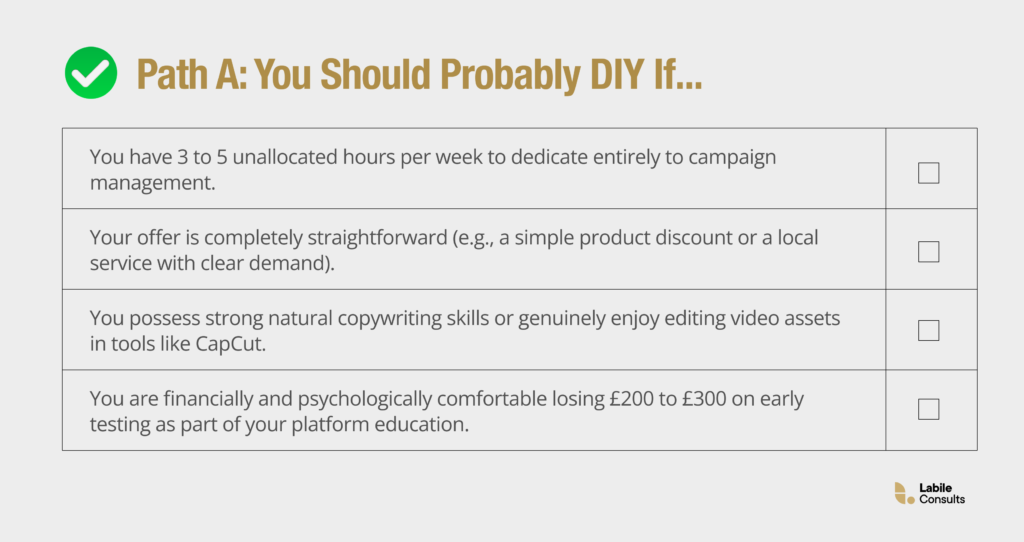
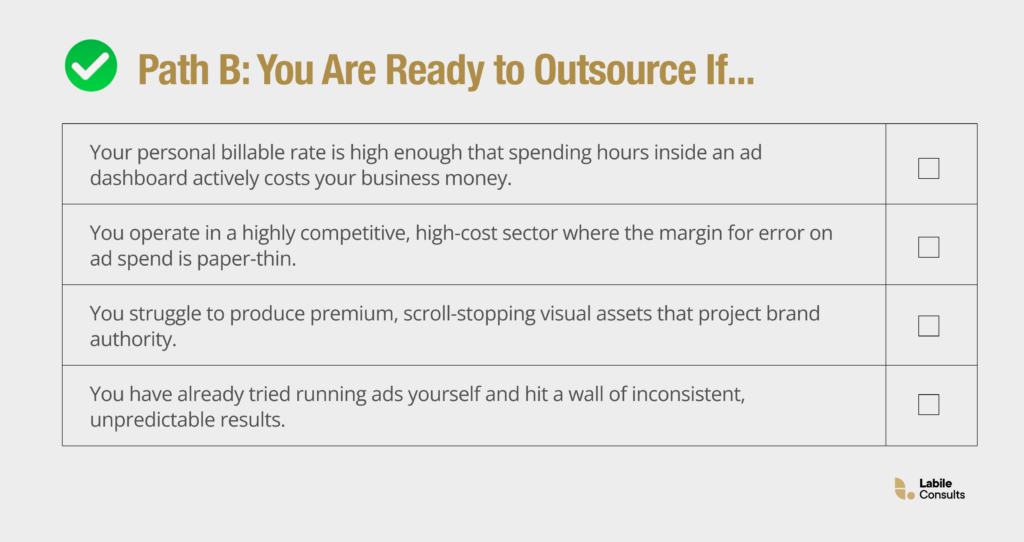
Instead of wading through more marketing theory, check the boxes below that match your current operational reality to find your direction:
Path A: You Should Probably DIY If…
Path B: You Are Ready to Outsource If…
The Verdict: If you ticked 3 or 4 points under Path A, you have the operational runway to manage your own campaigns. Head straight to our DIY checklist below.
If you checked 2 or more points under Path B, your time is better spent scaling your business while a specialist handles the dashboard; skip ahead to see how to protect your budget when outsourcing.
If You Decide to DIY, Where Should You Begin?
You do not need a complex, chaotic campaign structure to see results. To run Facebook Ads for small businesses successfully on your own, skip the complicated testing setups and focus entirely on this foundational, four-step framework:
- The Strategy: Launch a Retargeting Safety Net First
Instead of wasting money trying to find total strangers, target your “warmest” audience first. Set up a Custom Audience in Meta Ads Manager consisting of people who have visited your website or engaged with your Instagram and Facebook pages over the past 90 days. This audience already knows your brand name, making them significantly cheaper to convert and giving you fast, clean data to test your messaging.
- The Setup: Trust Advantage+ Audience
Do not spend hours manually layering complicated interest groups or demographic behaviours. Meta’s AI engine is now built to find your buyers automatically, especially since the Andromeda update. Leave your targeting broad, simply select your geographic location and let Meta’s algorithm locate your customers based on how they interact with your creative.
- The Asset: Let Your Creative Do the Heavy Lifting
Because you are using broad targeting, your ad creative is your actual targeting tool.
- The Hook: Use vertical video (Reels) or a single, high-contrast image with a text overlay that explicitly names your ideal customer in the first 3 seconds (e.g., “Attention Manchester Homeowners”).
- The Action: Keep your caption focused on a single, clear call to action. Do not ask them to read a blog, follow your page, and buy a product. Pick one definitive goal per campaign.
- The Data: Enforce the 14-Day Machine Learning Rule
Once you hit “Publish,” step away from the dashboard. Meta requires approximately 50 optimisation events to exit its volatile learning phase and stabilise its costs.
If you panic and switch your ads off after three days because you haven’t seen an immediate flood of enquiries, you are throwing your budget away. Commit to a minimum two-week calculation period before making any adjustments.
Not Sure Which Path Is Right for Your Business?
Without doubt, Facebook ads for small businesses still work. However, now, success requires picking either a disciplined DIY approach or outsourcing entirely. The inconsistent middle ground only wastes budget. If you are unsure which path aligns with your current resources, the expert media buyers at Labile Consults can help you build a systemised strategy for your Facebook business advertising or train you to run your own Facebook ads campaigns confidently.
Book a free consultation today, and let’s work out the right approach for Facebook ads for your small business.