
Most business owners fall into one of two camps when it comes to SEO. Either they hand it off entirely to an agency and hope for the best, or they try to tackle it themselves, get overwhelmed by conflicting advice, and give up within a month. Neither tends to produce good results.
At its simplest, Search Engine Optimization (SEO) is the process of making your website ‘legible’ and ‘authoritative’ to search engines so they feel confident recommending you to users. While off-page SEO deals with your reputation across the web, on-page SEO strategies focus entirely on what you can control: the content, structure, and performance of your own site.
Note: If you’re just getting started, our guide on on-page SEO for small businesses covers the foundational definitions in full. This article builds on that by focusing on a deep, 2026-ready implementation.
You see, the most effective on-page SEO strategies are not complicated. They reward consistency and clear thinking far more than technical expertise. And for a business owner who understands their customers, their market, and what makes their offering worth choosing, the raw material for strong SEO is already there.
However, having the right materials is only half the battle. The real challenge lies in how you assemble them, and to get it right, we first have to look at why the DIY approach so often falls short.
Why Most Business Owners Get On-Page SEO Wrong
The most common mistake is treating on-page SEO as a series of boxes to tick rather than an integrated approach to communicating with search engines. Business owners optimise a few pages, add some keywords, and then wonder why nothing moved after three months.
On-page SEO strategies only work when they’re applied consistently and in relation to each other. Your keyword placement only works if your content is genuinely useful. Your heading structure only works if it reflects what the page actually contains. Your meta description only matters if your title tag has already earned the click.
Each element reinforces the others, and gaps in any one area limit the whole.
However, even a perfectly built page will fail if it’s built for the wrong person. This leads to the second mistake: optimising for search engines before understanding what your customers are actually searching for.
SEO for business owners has to start with customer search intent, the specific questions, phrases, and problems your target audience types into Google when they need what you offer. Everything else flows from that.
Once you have decoded what your audience actually wants to find, the task becomes translating that intent into a structure that search engines can’t ignore.
To do this effectively in 2026, you must focus on the following high-impact tactics. These are the on-page SEO strategies that actually move the needle for your business.
Top 7 On-Page SEO Strategies You Should Start With
1. Build Each Page Around One Specific Keyword
Every page on your website should target one primary keyword, the phrase your ideal customer is most likely to search when looking for what that page offers. Not a vague topic. A specific phrase with real search volume behind it.
The reason business owners struggle here is that they tend to think in terms of their offer (“we do graphic design”) rather than their customers’ search behaviour (“freelance graphic designer for startups London”). The more specific your keyword, the less competition you face and the more intent-matched the traffic you attract.
To find the right keyword for each page, use a combination of Google’s autocomplete (type your topic and see what suggestions appear) and free or low-cost keyword research tools.
As Gaurav Sharma at Attrock explains in his breakdown of on-page SEO strategies, factoring in search volume, keyword competitiveness, and keyword value when picking terms gives you the highest chance of ranking for phrases you can realistically win.
However, finding the keyword is only the diagnostic phase; the next step is signalling that relevance to Google’s crawlers through strategic placement.
Once you have your keyword, it should appear in your H1, within the first 100 words of your content, in at least one subheading, in your URL, and in your meta description. That is the minimum threshold.
After that, use it where it fits naturally and fill the rest with related terms and synonyms. While these placements help Google categorise your page, they don’t actually persuade a human to click.
For that, you need to shift your focus from search signals to sales copy.
2. Treat Your Title Tag and Meta Description as a Two-Line Advertisement
The title tag and meta description are what a potential customer sees before they decide whether to visit your website. Most business owners either ignore these entirely or write something generic that could describe any business in their sector.
Your title tag, the blue clickable headline in search results, should be between 50 and 60 characters, include your primary keyword, and be specific enough to distinguish you from every other result on the page. “Accounting Services” is not a title tag. “Small Business Accountant in Bristol: Fixed Monthly Fees” is.
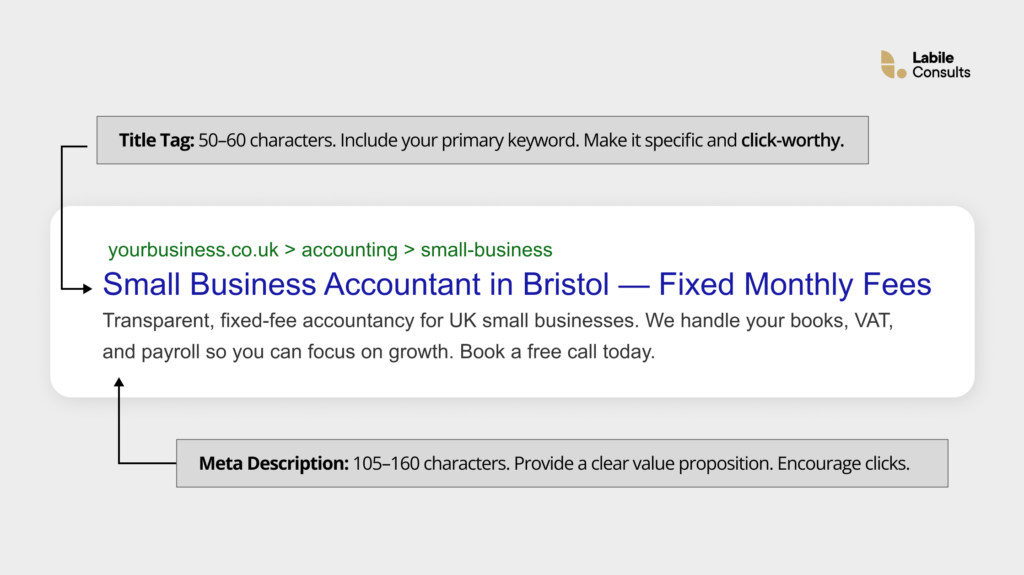
Your meta description, the grey text beneath the title, should be between 105 and 160 characters and give the reader one clear reason to choose your page over the alternatives. Think of it as a one-sentence pitch. It does not directly affect your search ranking, but it significantly affects your click-through rate, which in turn is one of the search engine ranking factors Google uses to assess how valuable your page is to real users.
Strong meta descriptions and title tags are among the fastest wins in SEO for business owners because most small-business websites leave them blank or use auto-generated ones. You can outperform competitors simply by writing them with care.
But a great advertisement is only successful if the ‘storefront’ the user lands on is just as organised. This is where your heading structure becomes critical; it is what shows that you can deliver on your promises.
3. Use Headings to Signal Structure, Not Just Style
Most business owners use headings for visual reasons. Mostly to break up blocks of text and make pages look less dense. That’s a valid reason, but it misses the more important function: headings are one of the clearest signals you can send to Google about the structure and content of your page.
Every page needs one H1, the main title, which should include your primary keyword. Under that, use H2s for each major section and H3s for subsections within those. This hierarchy tells Google what the page covers and how the content is organised, which directly influences whether it surfaces for relevant queries.
The practical SEO rule for business owners is to make your headings descriptive enough to stand alone.
If someone reads only your headings, they should be able to understand what the page covers and the order in which it covers it. Headings like “Our Approach” or “Why Choose Us” tell Google almost nothing. “How Our Fixed-Fee Accounting Works for UK Small Businesses” tells Google exactly what to expect from that section.
While headings provide the skeleton of your page, the actual meat, the content itself, must be substantial enough to keep the reader from hitting the ‘back’ button.”
4. Write Content That Earns Its Place on the Page
This is where on-page SEO strategies converge with actual business judgement. Google is increasingly able to distinguish between content that genuinely helps readers and content written primarily for search engines. The former ranks; the latter stagnates.
So, what then makes content earn its place? It answers the question the reader actually came with. It uses specific, real-world language rather than generic descriptions. It reflects genuine experience with the subject.
For business owners, the advantage here is that you know your subject, your customers, and your market better than a generic content writer does.
According to Joseph Edgar, writing in Forbes, authentic visuals, genuine customer stories, and real-world detail carry more weight in modern search than keyword density alone.
These are the things that satisfy search intent and build the kind of trust that turns a first-time visitor into an enquiry.
And more so, in 2026, we are optimising for AI-generated summaries, making your ‘human advantage’ more vital than ever. Google’s E-E-A-T framework now prioritises Information Gain. To rank, your content must provide unique insights, not just repeat existing search results.
To rank alongside these summaries, you must:
- Lead with Direct Answers: Start sections with a clear, declarative sentence that AI can easily “clip.”
- Inject First-Person Insights: Use phrases like “In our experience” or “What we’ve noticed in the market.”
- Use Proprietary Data: Share specific outcomes or unique processes that an AI cannot hallucinate or scrape from a competitor.
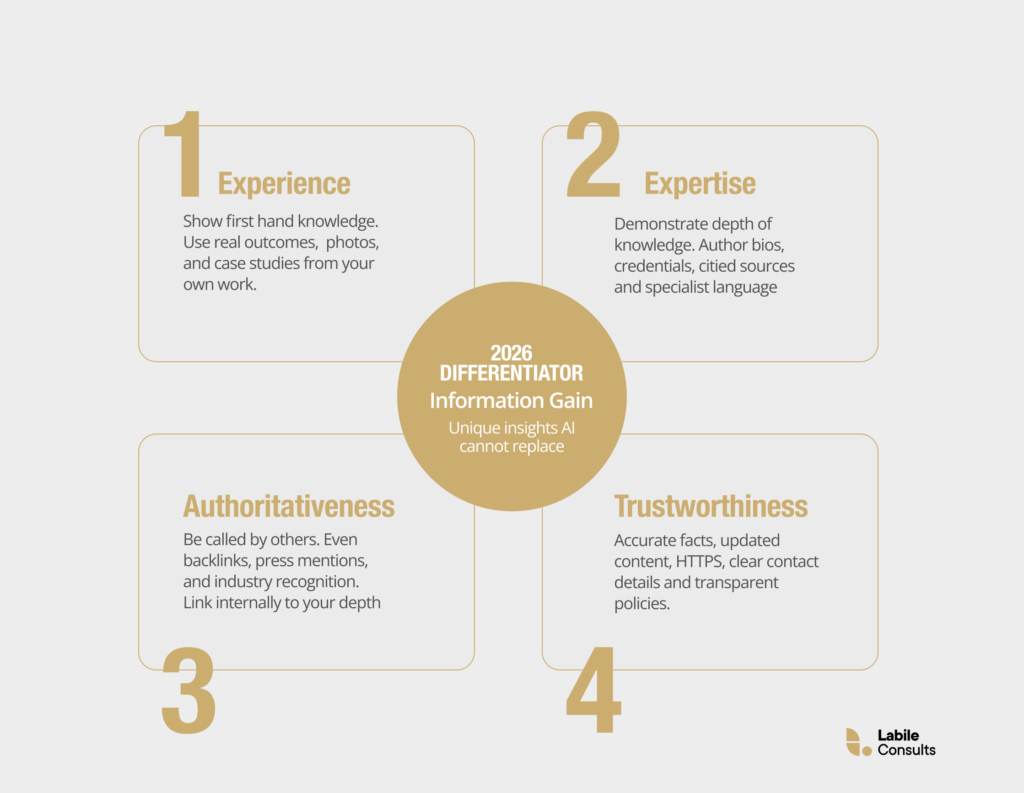
Once you have established this level of unique value on the page, the next step is to ensure Google can find the rest of your expertise through your site’s internal architecture.
5. Build Internal Links Deliberately, Not Incidentally
Internal links, which are links from one page on your website to another, are one of the most underused on-page SEO strategies in the small business context. Most business owners add them as an afterthought, if at all. Used well, they are a straightforward way to strengthen your site’s architecture and help Google understand which pages are most important.
The logic is simple. When a high-performing page on your site links to a page you want to rank, it passes some of its authority to that page. It also tells Google that those two pages are related, which improves the contextual understanding of both. And for your visitors, a well-placed internal link guides them to the next logical step in their journey through your site, keeping them engaged longer.
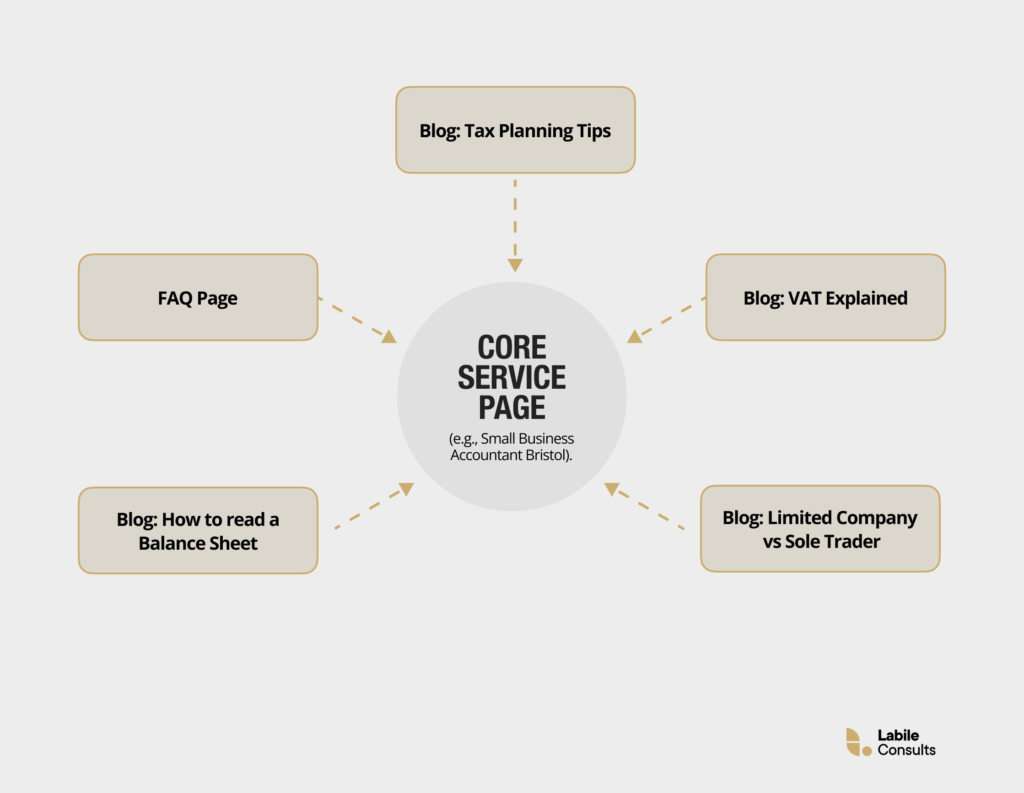
But note that the anchor text, the words the link is placed on, matters. Avoid “click here” or “read more.” Use descriptive phrases that reflect the content of the page being linked to. If you’re linking to your pricing page from a blog post, the anchor text “see our fixed monthly accounting fees” is far more useful to both Google and your reader than “find out more.”
Strategically linking your best ideas is vital, but those links lose their value if the pages they point to gather digital dust.
6. Refresh Existing Pages Before Publishing New Ones
One of the most counterproductive habits in content marketing is the compulsion to publish new pages while existing pages sit underperforming. Google does not simply reward volume; it rewards relevance and currency. A page that was accurate two years ago but now contains outdated information, broken links, or references to products you no longer offer actively works against you.
Refreshing an existing page is almost always faster than creating a new one, and the SEO returns are often better. When you update a page, adding new details, correcting outdated information, improving the heading structure, and strengthening the internal links, you give Google a reason to re-crawl and re-evaluate it. Pages with existing authority improve their rankings faster than brand-new pages starting from zero.
Even small updates, such as refreshing outdated statistics, improving heading clarity, and adding internal links to newer content can turn a dormant piece of content into a top performer. The key is to identify which pages have the most potential (they rank on pages two or three but haven’t broken through) and prioritize those first.
What you can do is check once a quarter which of your key pages have declined in rankings or traffic. Update them before you create anything new.
While content strategy and updates drive relevance, they can still be undermined by a poor user experience. The final piece of the on-page puzzle is ensuring your website’s engine is running smoothly.
7. Get the Technical Basics Right
On-page SEO isn’t just about what you write; it’s about how your site performs. In fact, this is perhaps one of the most important on-page SEO strategies you need to prioritise as a business owner. Now, you don’t need to be a developer to win here, but you do need to address four specific ranking factors:
- Page Speed: Use a tool like TinyPNG to compress images before uploading and remove any unused plugins.
- Mobile Experience: Ensure your buttons are “thumb-friendly” and text doesn’t overflow on small screens. Google uses mobile-first indexing; if it fails on a phone, it fails everywhere.
- URL Structure: Keep them short and keyword-rich
- Image Alt Text: Write a five-word description for every image. It helps accessibility and gives Google extra context.
So, How Do You Put These On-Page SEO Strategies Into Practice?
You don’t need to implement all these SEO strategies all at once. Start with your most important service page, apply these steps, and move to the next in order of priority.
On-page SEO is an ongoing discipline, not a one-time project. Unlike paid advertising, the effort you invest today compounds, delivering returns long after the initial work is done. Consistency is what separates high-ranking websites from those that stagnate.
If you would rather focus on running your business than managing your technical SEO, Labile Consults can take it off your plate. We build search strategies grounded in your specific goals and market.
Book a free consultation today, and let’s help get your website ranking top on Google SERPs.